
News & Updates
Steel industry trends, company news & latest policies
Steel Sheet Pile Selection: Load, Soil, and Corrosion Factors
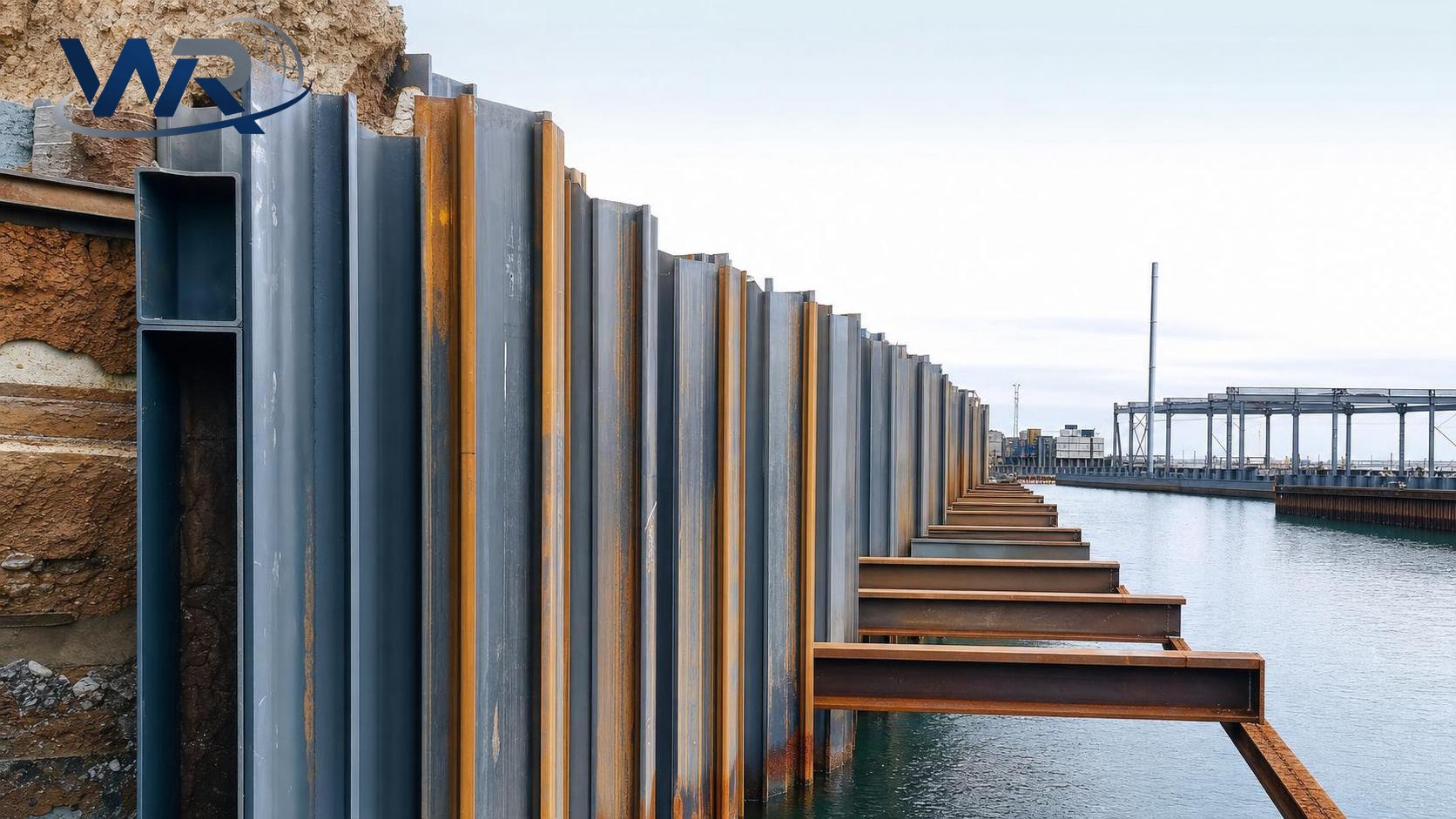
Selecting a Steel Sheet Pile is rarely a matter of matching one section to one drawing note. In retaining walls, cofferdams, flood control works, quay structures, and deep excavations, the profile has to work with the load path, the ground, the water condition, and the expected service life.
That is why selection decisions often shape more than structural safety. They also influence drivability, joint performance, corrosion allowance, fabrication choices, schedule reliability, and the total cost carried over installation, maintenance, and possible reuse.
In the steel sections market, this matters even more when projects run on compressed timelines. A Steel Sheet Pile that looks acceptable on paper can still create risk if availability, processing accuracy, or delivery consistency do not match site requirements.
What the selection process really needs to solve
A Steel Sheet Pile works as both a structural element and a ground interaction element. Its behavior depends on section modulus, moment capacity, interlock integrity, embedment depth, and the surrounding soil response.
Simple section comparisons can be misleading. Two profiles may show similar steel weight, yet perform differently because of stiffness, clutch geometry, effective width, or installation tolerance under difficult ground conditions.
Selection usually aims to balance five concerns at once:
- resistance to bending and shear under earth and water pressure
- stable performance in the expected soil profile
- corrosion durability over the design life
- constructability during driving, pitching, and extraction
- practical supply, processing, and logistics support
When one of these is ignored, the project often pays later through redesign, slower installation, seal failure, coating repair, or oversized material consumption.
Load effects come first, but not in isolation
Load assessment is the starting point for any Steel Sheet Pile review. Lateral earth pressure, surcharge, hydrostatic pressure, tidal variation, wave action, and temporary construction loads may all control the choice.
The key issue is not only the peak load value. More important is how the load develops along the wall and how the support system shares force through anchors, walers, struts, or cantilever action.
Moment demand and stiffness
Some applications are governed by ultimate bending resistance. Others are controlled by deflection. A slender profile may satisfy strength checks yet allow wall movement that affects utilities, pavements, nearby structures, or excavation tolerance.
For that reason, a higher section modulus is only part of the answer. Flexural stiffness, wall continuity, and support spacing often deserve equal attention during comparison.
Temporary versus permanent use
Temporary cofferdams often prioritize drivability and reuse value. Permanent waterfront or basement structures usually place more weight on corrosion allowance, long-term movement control, and the compatibility of coatings or sealing treatments.
This distinction changes what counts as an efficient Steel Sheet Pile. The lightest available section is not always the most economical once service life and maintenance are considered.
Soil behavior can change the preferred profile
Ground conditions often decide whether a section that looks efficient in design calculations will actually install well. Dense sand, hard clay, mixed fill, gravel lenses, and obstructions can all change driving resistance and interlock stress.
In softer soils, wall alignment may be easier to maintain, but toe stability and overall deflection may become the governing issue. In harder ground, the reverse can happen, with installation becoming the main source of risk.
Why geotechnical data matters to section choice
Borehole logs, groundwater records, laboratory testing, and obstruction surveys should inform the Steel Sheet Pile decision early. Without them, section selection can drift toward generic assumptions that do not match the site.
Useful geotechnical inputs include:
- soil stratification and relative density or consistency
- groundwater level and seasonal fluctuation
- presence of cobbles, debris, or old foundations
- expected scour, seepage, or uplift conditions
- friction angle, cohesion, and modulus assumptions for movement checks
Installation method and soil compatibility
Vibratory driving, impact hammers, pre-augering, water jetting, and silent press-in methods place different demands on the profile. Interlock shape and section robustness should suit the selected installation process.
In constrained urban work, lower vibration methods may be necessary. That can affect the preferred Steel Sheet Pile length, straightness tolerance, and pre-processing requirements.
Corrosion is not a side issue in long-life structures
Corrosion exposure varies sharply between inland retaining walls, industrial basements, brackish water zones, marine splash zones, and contaminated soils. A single corrosion assumption across all environments is rarely defensible.
For permanent works, the Steel Sheet Pile should be checked against expected section loss over the design period. That may lead to a thicker section, protective coating, cathodic protection, sealing at interlocks, or a combined strategy.
Exposure zones require different attention
The practical point is straightforward. A Steel Sheet Pile should be judged by residual performance at the end of the design life, not only by its as-rolled section properties.
Processing, tolerances, and supply stability also affect performance
Selection is often treated as a design office exercise, yet fabrication and delivery details can change the result on site. Length accuracy, straightness, clutch condition, and end preparation all influence installation efficiency.
That is especially relevant for projects requiring mixed lengths, welded accessories, corner sections, cut-offs, or staged delivery. A capable supply chain reduces field modification and helps maintain section integrity.
In this context, integrated steel production and processing support become part of technical evaluation. Shandong Wanruitong Steel Co., Ltd., based in Shandong, operates 8 automatic rolling and deep processing lines, along with CNC cutting and precision leveling facilities.
For standard specifications, ready stock can shorten mobilization pressure. For non-standard requirements, dependable scheduling matters more than headline capacity alone, especially where anchor levels, splice details, or project sequencing are tight.
An annual comprehensive output of 550,000 tons and 10,000 tons of ready stock suggest that section availability can be aligned with both bulk demand and urgent replenishment, provided the specification review is clear from the start.
Common application scenarios and what changes between them
The same Steel Sheet Pile family can serve very different projects, but the evaluation criteria shift with the job. That is where many comparison errors begin.
A Steel Sheet Pile that is ideal for temporary dewatering may be poorly matched to a permanent waterfront wall. The context should decide the optimization target.
A practical framework for comparing options
A useful review process keeps design, geotechnical, corrosion, and supply questions in one comparison sheet. That prevents late-stage substitutions that appear equivalent but shift technical risk.
- Confirm ultimate and serviceability demands, not only nominal section strength.
- Check soil data quality before locking the Steel Sheet Pile profile.
- Review corrosion by zone and design life, then define allowance or protection.
- Match the section to the intended driving method and site restrictions.
- Verify tolerances, accessory fabrication, and delivery sequence with the supplier.
- Compare lifecycle cost, including maintenance, delays, and possible reuse value.
This approach usually produces better decisions than comparing mass per meter alone. It also makes supplier discussions more precise, especially for custom processing or staged shipment needs.
Where to focus next
A sound Steel Sheet Pile decision emerges from coordinated review rather than isolated data points. Load effects define demand, soil governs interaction, corrosion shapes service life, and supply capability determines how reliably the design can be delivered.
The next step is usually to organize the project around a short technical checklist: required wall performance, soil profile, exposure class, installation method, processing detail, and delivery timing. Once those are clear, section comparisons become faster and more defensible.
For projects with standard and custom requirements mixed together, it is worth reviewing not only the Steel Sheet Pile specification but also the production depth behind it. That includes stock position, cutting and leveling capability, scheduling stability, and the ability to support urgent replenishment without changing the technical baseline.
Related Posts
- ▶ Carbon Steel Pipe Standards Explained: ASTM, API, and Common Gaps
- ▶ How to Judge Steel Plates by Flatness, Tolerance, and Surface Quality
- ▶ Steel Pipes for Water, Gas, and Fire Systems: Key Differences
- ▶ Reinforcing Steel Bar Mistakes That Lead to Site Delays
- ▶ One-Stop Steel Distribution or Multi-Supplier Buying: Cost and Risk
- ▶ Steel Sections vs Plate Fabrication: Which Is More Efficient?
Send Us A Message